Key facts

Date
March 9, 2035
Type
Annular eclipse
Duration of annularity at eclipse maximum Duration of the annular phase at the point of greatest eclipse.
0 min 48 s
Global eclipse maximum
at 23:04 UTC UTC (Coordinated Universal Time): the worldwide time standard, independent of local time zones and daylight saving time.
Coordinates of greatest eclipse
29.0° S – 155.0° W
Path width at maximum
about 31 km
Saros series Number of the Saros series to which the eclipse belongs: similar eclipses recur about every 18 years and 11 days, with a comparable type and path, though not over the same locations each time.
140
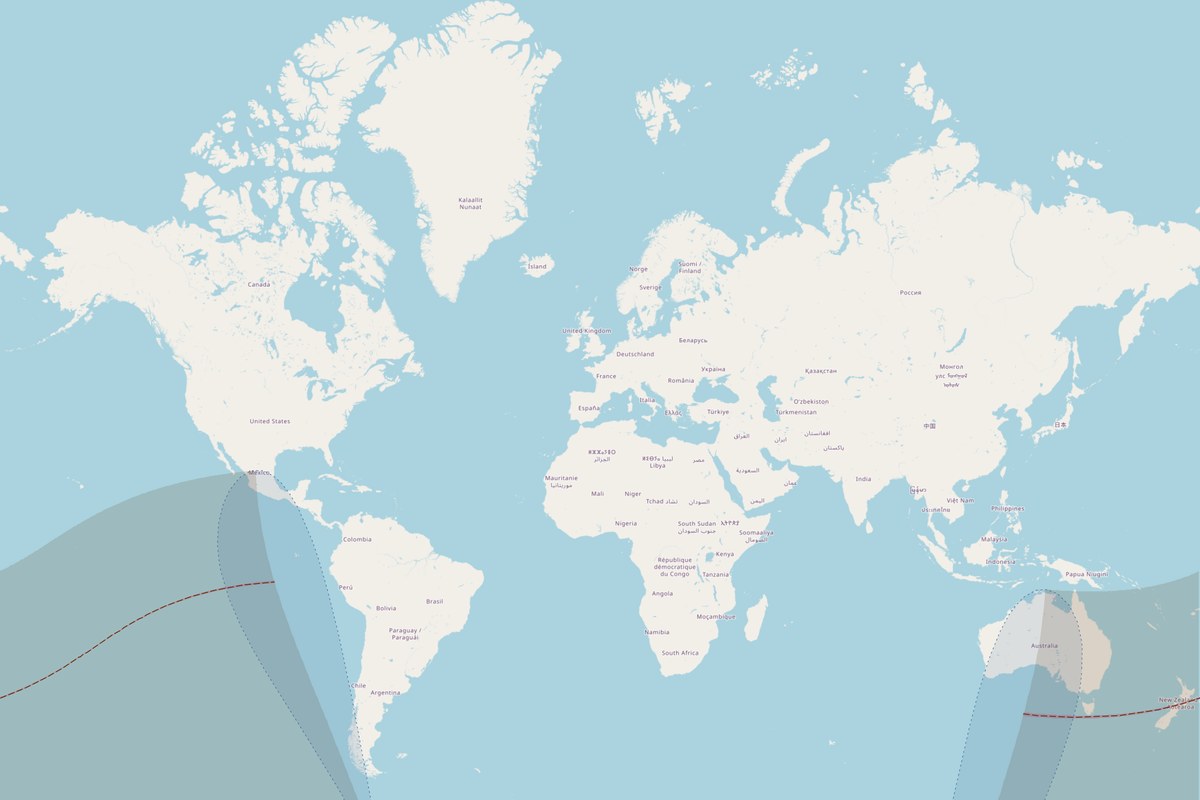
Visibility map — Annular eclipse on March 9, 2035

Choose a location anywhere on Earth to see if the eclipse will be visible, check local times, and watch it unfold in an animation.

Explore the eclipse

The path of annularity of this solar eclipse crosses New Zealand and then reaches the eastern Tuamotu in French Polynesia. Along it, the Moon leaves a slender ring for about 48 seconds at maximum. Partial phases spread across a broader South Pacific region, including Australia, the Cook Islands, Easter Island, and Antarctica.

Path of annularity

Regions
New Zealand (Nelson, Wellington, Hawke’s Bay), French Polynesia (eastern Tuamotu)
Example destinations
New ZealandFrench Polynesia

To look at the Sun: wear eclipse glasses throughout the eclipse — the ring of fire remains dangerous.

NelsonNew Zealand

View the eclipse
Key moments of the eclipse
Key moment Local time Obscuration Comment
Partial — start
Sat, Mar 10
Obscuration 0%
The Moon starts covering the Sun
Annularity — start
Sat, Mar 10
Obscuration 97.3%
Only a ring of sunlight remains
Maximum
Sat, Mar 10
Obscuration 97.3%
Maximum obscuration
Annularity — end
Sat, Mar 10
Obscuration 97.4%
The ring of sunlight is no longer complete
Partial — end
Sat, Mar 10
Obscuration 0%
The Moon no longer covers the Sun

ParaparaumuNew Zealand

View the eclipse
Key moments of the eclipse
Key moment Local time Obscuration Comment
Partial — start
Sat, Mar 10
Obscuration 0%
The Moon starts covering the Sun
Annularity — start
Sat, Mar 10
Obscuration 97.4%
Only a ring of sunlight remains
Maximum
Sat, Mar 10
Obscuration 97.4%
Maximum obscuration
Annularity — end
Sat, Mar 10
Obscuration 97.4%
The ring of sunlight is no longer complete
Partial — end
Sat, Mar 10
Obscuration 0%
The Moon no longer covers the Sun

MastertonNew Zealand

View the eclipse
Key moments of the eclipse
Key moment Local time Obscuration Comment
Partial — start
Sat, Mar 10
Obscuration 0%
The Moon starts covering the Sun
Annularity — start
Sat, Mar 10
Obscuration 97.4%
Only a ring of sunlight remains
Maximum
Sat, Mar 10
Obscuration 97.4%
Maximum obscuration
Annularity — end
Sat, Mar 10
Obscuration 97.5%
The ring of sunlight is no longer complete
Partial — end
Sat, Mar 10
Obscuration 0%
The Moon no longer covers the Sun

PoriruaNew Zealand

View the eclipse
Key moments of the eclipse
Key moment Local time Obscuration Comment
Partial — start
Sat, Mar 10
Obscuration 0%
The Moon starts covering the Sun
Annularity — start
Sat, Mar 10
Obscuration 97.4%
Only a ring of sunlight remains
Maximum
Sat, Mar 10
Obscuration 97.4%
Maximum obscuration
Annularity — end
Sat, Mar 10
Obscuration 97.4%
The ring of sunlight is no longer complete
Partial — end
Sat, Mar 10
Obscuration 0%
The Moon no longer covers the Sun

ReaoFrench Polynesia

View the eclipse
Key moments of the eclipse
Key moment Local time Obscuration Comment
Partial — start
Fri, Mar 9
Obscuration 0%
The Moon starts covering the Sun
Annularity — start
Fri, Mar 9
Obscuration 97.9%
Only a ring of sunlight remains
Maximum
Fri, Mar 9
Obscuration 97.9%
Maximum obscuration
Annularity — end
Fri, Mar 9
Obscuration 97.9%
The ring of sunlight is no longer complete
Partial — end
Fri, Mar 9
Obscuration 0%
The Moon no longer covers the Sun

Areas with a partial eclipse

Regions
New Zealand, Australia, French Polynesia, Cook Islands, Easter Island, Antarctica
Example destinations
New ZealandAustraliaFrench PolynesiaCook IslandsChile

To look at the Sun: eclipse glasses for the whole eclipse.

WellingtonNew Zealand

View the eclipse
Key moments of the eclipse
Key moment Local time Obscuration Comment
Partial — start
Sat, Mar 10
Obscuration 0%
The Moon starts covering the Sun
Maximum
Sat, Mar 10
Obscuration 97.4%
Maximum obscuration
Partial — end
Sat, Mar 10
Obscuration 0%
The Moon no longer covers the Sun

AucklandNew Zealand

View the eclipse
Key moments of the eclipse
Key moment Local time Obscuration Comment
Partial — start
Sat, Mar 10
Obscuration 0%
The Moon starts covering the Sun
Maximum
Sat, Mar 10
Obscuration 83.8%
Maximum obscuration
Partial — end
Sat, Mar 10
Obscuration 0%
The Moon no longer covers the Sun

ChristchurchNew Zealand

View the eclipse
Key moments of the eclipse
Key moment Local time Obscuration Comment
Partial — start
Sat, Mar 10
Obscuration 0%
The Moon starts covering the Sun
Maximum
Sat, Mar 10
Obscuration 91.3%
Maximum obscuration
Partial — end
Sat, Mar 10
Obscuration 0%
The Moon no longer covers the Sun

QueenstownNew Zealand

View the eclipse
Key moments of the eclipse
Key moment Local time Obscuration Comment
Partial — start
Sat, Mar 10
Obscuration 0%
The Moon starts covering the Sun
Maximum
Sat, Mar 10
Obscuration 88.4%
Maximum obscuration
Partial — end
Sat, Mar 10
Obscuration 0%
The Moon no longer covers the Sun

HobartAustralia

View the eclipse
Key moments of the eclipse
Key moment Local time Obscuration Comment
Sunrise
Sat, Mar 10
Obscuration 0%
Sun’s centre on the horizon
Partial — start
Sat, Mar 10
Obscuration 0%
The Moon starts covering the Sun
Maximum
Sat, Mar 10
Obscuration 93.9%
Maximum obscuration
Partial — end
Sat, Mar 10
Obscuration 0%
The Moon no longer covers the Sun

MelbourneAustralia

View the eclipse
Key moments of the eclipse
Key moment Local time Obscuration Comment
Sunrise
Sat, Mar 10
Obscuration 0%
Sun’s centre on the horizon
Partial — start
Sat, Mar 10
Obscuration 0%
The Moon starts covering the Sun
Maximum
Sat, Mar 10
Obscuration 75.6%
Maximum obscuration
Partial — end
Sat, Mar 10
Obscuration 0%
The Moon no longer covers the Sun

SydneyAustralia

View the eclipse
Key moments of the eclipse
Key moment Local time Obscuration Comment
Partial — start
Sat, Mar 10
Obscuration 0%
The Moon starts covering the Sun
Maximum
Sat, Mar 10
Obscuration 61.7%
Maximum obscuration
Partial — end
Sat, Mar 10
Obscuration 0%
The Moon no longer covers the Sun

CanberraAustralia

View the eclipse
Key moments of the eclipse
Key moment Local time Obscuration Comment
Sunrise
Sat, Mar 10
Obscuration 0%
Sun’s centre on the horizon
Partial — start
Sat, Mar 10
Obscuration 0%
The Moon starts covering the Sun
Maximum
Sat, Mar 10
Obscuration 66.6%
Maximum obscuration
Partial — end
Sat, Mar 10
Obscuration 0%
The Moon no longer covers the Sun

PapeeteFrench Polynesia

View the eclipse
Key moments of the eclipse
Key moment Local time Obscuration Comment
Partial — start
Fri, Mar 9
Obscuration 0%
The Moon starts covering the Sun
Maximum
Fri, Mar 9
Obscuration 74.3%
Maximum obscuration
Partial — end
Fri, Mar 9
Obscuration 0%
The Moon no longer covers the Sun

Bora BoraFrench Polynesia

View the eclipse
Key moments of the eclipse
Key moment Local time Obscuration Comment
Partial — start
Fri, Mar 9
Obscuration 0%
The Moon starts covering the Sun
Maximum
Fri, Mar 9
Obscuration 67%
Maximum obscuration
Partial — end
Fri, Mar 9
Obscuration 0%
The Moon no longer covers the Sun

RaivavaeFrench Polynesia

View the eclipse
Key moments of the eclipse
Key moment Local time Obscuration Comment
Partial — start
Fri, Mar 9
Obscuration 0%
The Moon starts covering the Sun
Maximum
Fri, Mar 9
Obscuration 96.7%
Maximum obscuration
Partial — end
Fri, Mar 9
Obscuration 0%
The Moon no longer covers the Sun

RarotongaCook Islands

View the eclipse
Key moments of the eclipse
Key moment Local time Obscuration Comment
Partial — start
Fri, Mar 9
Obscuration 0%
The Moon starts covering the Sun
Maximum
Fri, Mar 9
Obscuration 66.4%
Maximum obscuration
Partial — end
Fri, Mar 9
Obscuration 0%
The Moon no longer covers the Sun

Easter IslandChile

View the eclipse
Key moments of the eclipse
Key moment Local time Obscuration Comment
Partial — start
Fri, Mar 9
Obscuration 0%
The Moon starts covering the Sun
Maximum
Fri, Mar 9
Obscuration 47.6%
Maximum obscuration
Partial — end
Fri, Mar 9
Obscuration 0%
The Moon no longer covers the Sun
Sunset
Fri, Mar 9
Obscuration 0%
Sun’s centre on the horizon

Watch a solar eclipse safely

To look directly at the Sun, use eclipse glasses that conform to ISO 12312-2 and are in good condition. Ordinary sunglasses do not provide enough protection.

You may look at the Sun without glasses only during totality at your observing location, when its disc is completely covered by the Moon. Put them back on as soon as the Sun begins to reappear. During a partial or annular eclipse, eclipse glasses remain necessary for any direct viewing.

Do not use binoculars, a telescope, a camera, or any other optical instrument unless it is fitted with a suitable solar filter placed in front of the optics. Eclipse glasses are not sufficient in this case.

The information and times shown are provided for guidance only. Each observer must check local conditions and follow the applicable safety guidelines.