Total solar eclipse of August 23, 2044
Key facts
- Date
- August 23, 2044
- Type
- Total eclipse
- Duration of totality at eclipse maximum Duration of the annular phase at the point of greatest eclipse.
- 2 min 04 s
- Maximum obscuration
- —
- Global eclipse maximum
- at 01:15 UTC UTC (Coordinated Universal Time): the worldwide time standard, independent of local time zones and daylight saving time.
- Coordinates of greatest eclipse
- 64.3° N – 120.5° W
- Path width at maximum
- about 454 km
- Saros series Number of the Saros series to which the eclipse belongs: similar eclipses recur about every 18 years and 11 days, with a comparable type and path, though not over the same locations each time.
- 126
- Regions
- Canada, United States and Greenland
- Example locations
- Dawson Creek, Fort Nelson, Thule
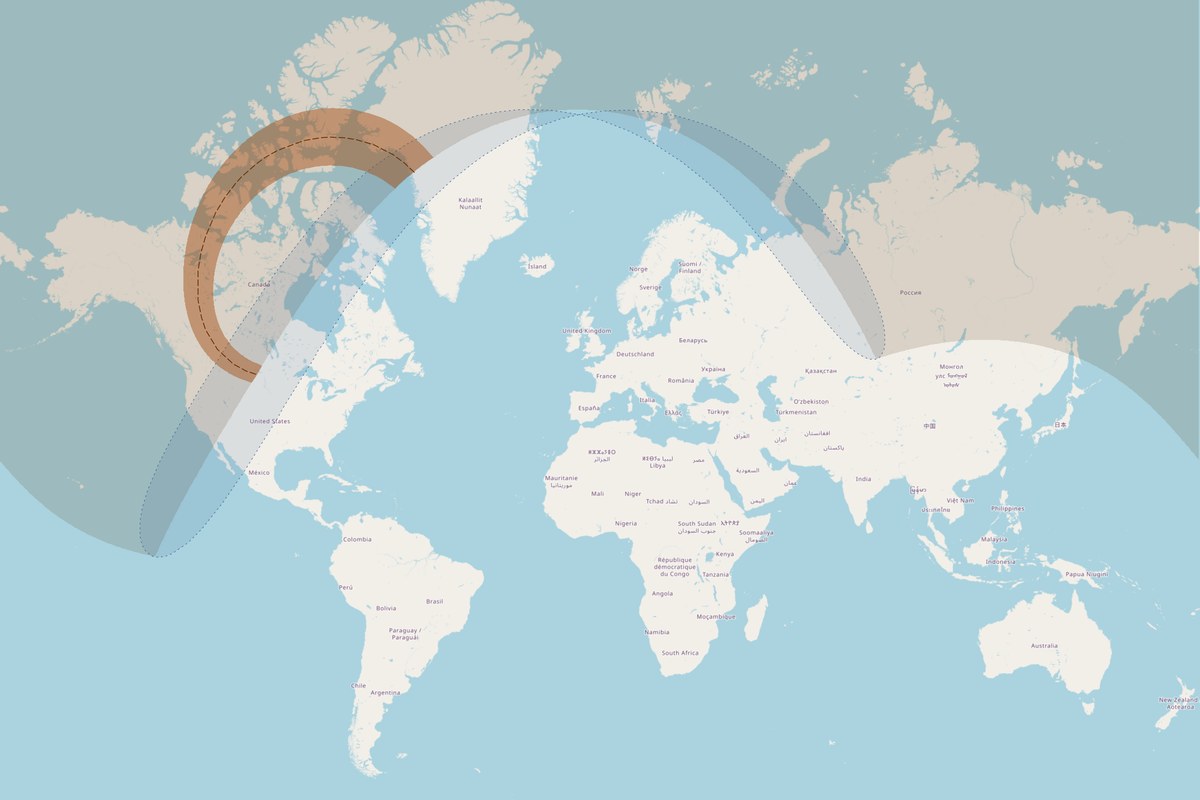
Choose a location anywhere on Earth to see if the eclipse will be visible, check local times, and watch it unfold in an animation.
Explore the eclipseCentral totality along a path through Canada, United States and Greenland lasts up to about 2 min 04 s.