Key facts

Date
December 16, 2047
Type
Partial eclipse
Maximum obscuration
85.5%
Global eclipse maximum
at 23:49 UTC UTC (Coordinated Universal Time): the worldwide time standard, independent of local time zones and daylight saving time.
Coordinates of greatest eclipse
66.8° S – 6.7° W
Saros series Number of the Saros series to which the eclipse belongs: similar eclipses recur about every 18 years and 11 days, with a comparable type and path, though not over the same locations each time.
123
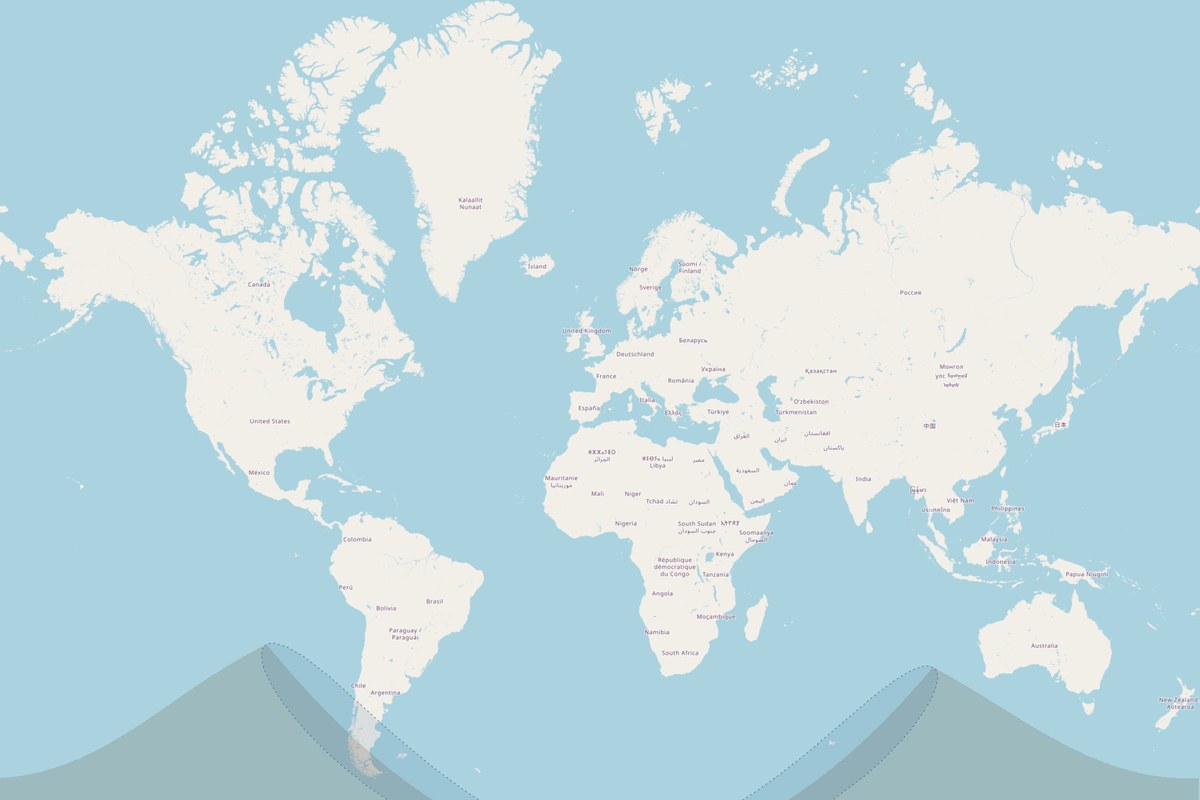
Visibility map — Partial eclipse on December 16, 2047

Choose a location anywhere on Earth to see if the eclipse will be visible, check local times, and watch it unfold in an animation.

Explore the eclipse

This partial solar eclipse covers the far south of South America, the Falkland Islands, Kerguelen, and Antarctica. The Moon hides a substantial share of the Sun over Tierra del Fuego and southern Patagonia. No path of totality or annularity appears.

Discover where to watch the eclipse

Areas with a partial eclipse

Regions
Patagonia, Falklands, Kerguelen, Antarctica
Example destinations
ArgentinaChileFalkland IslandsFrench Southern and Antarctic LandsAntarctica

To look at the Sun: eclipse glasses for the whole eclipse.

UshuaiaArgentina

View the eclipse
Key moments of the eclipse
Key moment Local time Obscuration Comment
Partial — start
Mon, Dec 16
Obscuration 0%
The Moon starts covering the Sun
Maximum
Mon, Dec 16
Obscuration 61.5%
Maximum obscuration
Sunset
Mon, Dec 16
Obscuration 20.5%
Sun’s centre on the horizon
Partial — end
Mon, Dec 16
Obscuration 0%
Sun has set

Punta ArenasChile

View the eclipse
Key moments of the eclipse
Key moment Local time Obscuration Comment
Partial — start
Mon, Dec 16
Obscuration 0%
The Moon starts covering the Sun
Maximum
Mon, Dec 16
Obscuration 58%
Maximum obscuration
Sunset
Mon, Dec 16
Obscuration 25.1%
Sun’s centre on the horizon
Partial — end
Mon, Dec 16
Obscuration 0%
Sun has set

CoyhaiqueChile

View the eclipse
Key moments of the eclipse
Key moment Local time Obscuration Comment
Partial — start
Mon, Dec 16
Obscuration 0%
The Moon starts covering the Sun
Sunset
Mon, Dec 16
Obscuration 34.3%
Sun’s centre on the horizon
Maximum
Mon, Dec 16
Obscuration 36.8%
Sun has set
Partial — end
Mon, Dec 16
Obscuration 0%
Sun has set

StanleyFalkland Islands

View the eclipse
Key moments of the eclipse
Key moment Local time Obscuration Comment
Partial — start
Mon, Dec 16
Obscuration 0%
The Moon starts covering the Sun
Sunset
Mon, Dec 16
Obscuration 22%
Sun’s centre on the horizon
Maximum
Mon, Dec 16
Obscuration 26.3%
Sun has set
Partial — end
Mon, Dec 16
Obscuration 0%
Sun has set

Kerguelen IslandsFrench Southern and Antarctic Lands

View the eclipse
Key moments of the eclipse
Key moment Local time Obscuration Comment
Partial — start
Tue, Dec 17
Obscuration 0%
Sun not yet risen
Maximum
Tue, Dec 17
Obscuration 26.4%
Sun not yet risen
Sunrise
Tue, Dec 17
Obscuration 23.4%
Sun’s centre on the horizon
Partial — end
Tue, Dec 17
Obscuration 0%
The Moon no longer covers the Sun

McMurdoAntarctica

View the eclipse
Key moments of the eclipse
Key moment Local time Obscuration Comment
Partial — start
Tue, Dec 17
Obscuration 0%
The Moon starts covering the Sun
Maximum
Tue, Dec 17
Obscuration 43%
Maximum obscuration
Partial — end
Tue, Dec 17
Obscuration 0%
The Moon no longer covers the Sun

Watch a solar eclipse safely

To look directly at the Sun, use eclipse glasses that conform to ISO 12312-2 and are in good condition. Ordinary sunglasses do not provide enough protection.

You may look at the Sun without glasses only during totality at your observing location, when its disc is completely covered by the Moon. Put them back on as soon as the Sun begins to reappear. During a partial or annular eclipse, eclipse glasses remain necessary for any direct viewing.

Do not use binoculars, a telescope, a camera, or any other optical instrument unless it is fitted with a suitable solar filter placed in front of the optics. Eclipse glasses are not sufficient in this case.

The information and times shown are provided for guidance only. Each observer must check local conditions and follow the applicable safety guidelines.