Key facts

Date
December 5, 2048
Type
Total eclipse
Duration of totality at eclipse maximum
3 min 28 s
Global eclipse maximum
at 15:35 UTC UTC (Coordinated Universal Time): the worldwide time standard, independent of local time zones and daylight saving time.
Coordinates of greatest eclipse
46.1° S – 56.4° W
Path width at maximum
about 160 km
Saros series Number of the Saros series to which the eclipse belongs: similar eclipses recur about every 18 years and 11 days, with a comparable type and path, though not over the same locations each time.
133
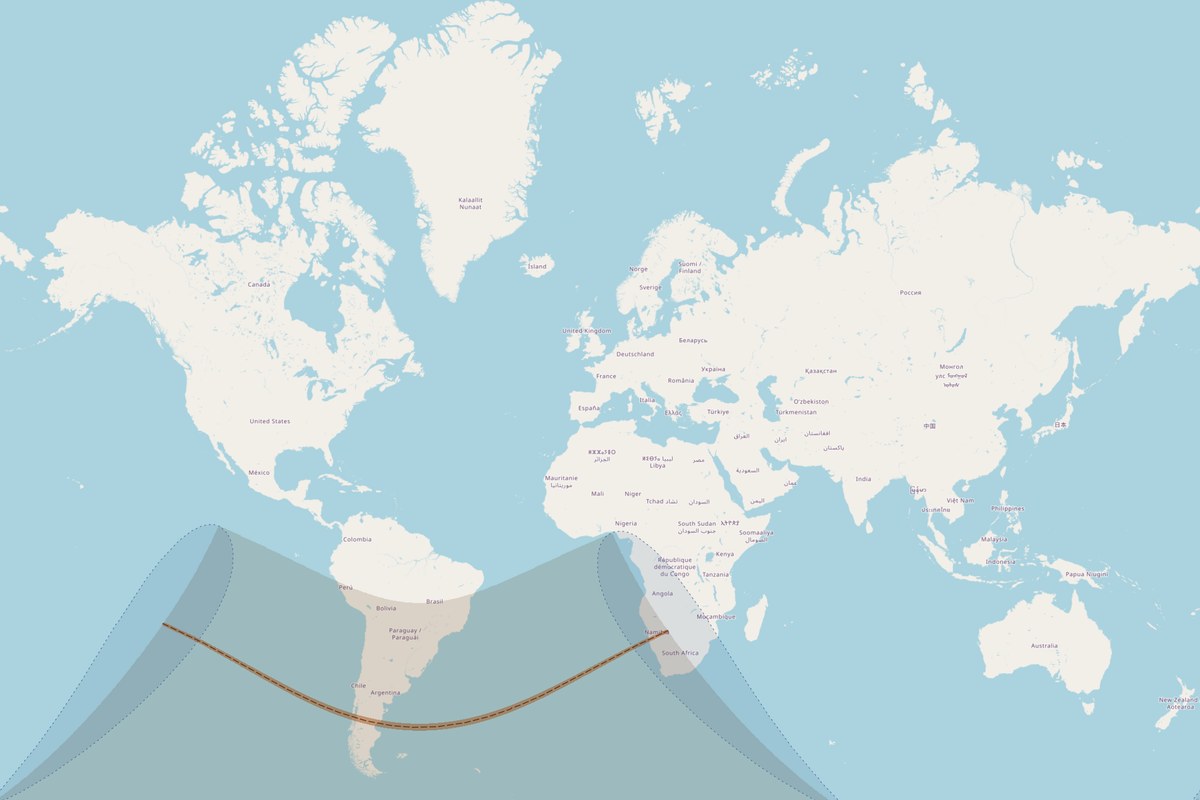
Visibility map — Total eclipse on December 5, 2048

Choose a location anywhere on Earth to see if the eclipse will be visible, check local times, and watch it unfold in an animation.

Explore the eclipse

The path of totality crosses Chilean and Argentine Patagonia, Tristan da Cunha, then Namibia. Within it, the Moon completely covers the Sun for about 3 minutes 28 seconds at maximum. A broader partial solar eclipse reaches Easter Island, the Falklands, South Georgia, Saint Helena, Uruguay, and wider areas of Chile, Argentina, and southern Africa.

Path of totality

Regions
Patagonia (Chile, Argentina), Tristan da Cunha, Namibia
Example destinations
ChileArgentinaTristan da CunhaNamibia

To look at the Sun: eclipse glasses, except during totality at your location.

Puerto CisnesChile

View the eclipse
Key moments of the eclipse
Key moment Local time Obscuration Comment
Partial — start
Sat, Dec 5
Obscuration 0%
The Moon starts covering the Sun
Start of totality
Sat, Dec 5
Obscuration 100%
The solar disc is completely covered by the Moon
Maximum
Sat, Dec 5
Obscuration 100%
Maximum obscuration
End of totality
Sat, Dec 5
Obscuration 100%
The Sun reappears — eclipse glasses required
Partial — end
Sat, Dec 5
Obscuration 0%
The Moon no longer covers the Sun

Comodoro RivadaviaArgentina

View the eclipse
Key moments of the eclipse
Key moment Local time Obscuration Comment
Partial — start
Sat, Dec 5
Obscuration 0%
The Moon starts covering the Sun
Start of totality
Sat, Dec 5
Obscuration 100%
The solar disc is completely covered by the Moon
Maximum
Sat, Dec 5
Obscuration 100%
Maximum obscuration
End of totality
Sat, Dec 5
Obscuration 100%
The Sun reappears — eclipse glasses required
Partial — end
Sat, Dec 5
Obscuration 0%
The Moon no longer covers the Sun

Edinburgh of the Seven SeasTristan da Cunha

View the eclipse
Key moments of the eclipse
Key moment Local time Obscuration Comment
Partial — start
Sat, Dec 5
Obscuration 0%
The Moon starts covering the Sun
Start of totality
Sat, Dec 5
Obscuration 100%
The solar disc is completely covered by the Moon
Maximum
Sat, Dec 5
Obscuration 100%
Maximum obscuration
End of totality
Sat, Dec 5
Obscuration 100%
The Sun reappears — eclipse glasses required
Partial — end
Sat, Dec 5
Obscuration 0%
The Moon no longer covers the Sun

KalkrandNamibia

View the eclipse
Key moments of the eclipse
Key moment Local time Obscuration Comment
Partial — start
Sat, Dec 5
Obscuration 0%
The Moon starts covering the Sun
Start of totality
Sat, Dec 5
Obscuration 100%
The solar disc is completely covered by the Moon
Maximum
Sat, Dec 5
Obscuration 100%
Maximum obscuration
End of totality
Sat, Dec 5
Obscuration 100%
The Sun reappears — eclipse glasses required
Sunset
Sat, Dec 5
Obscuration 59.6%
Sun’s centre on the horizon
Partial — end
Sat, Dec 5
Obscuration 0%
Sun has set

Areas with a partial eclipse

Regions
Easter Island, Falkland Islands, South Georgia, Saint Helena, Uruguay, Chile, Argentina, southern Africa
Example destinations
ChileFalkland IslandsSouth GeorgiaSaint HelenaUruguayArgentinaNamibiaBotswanaSouth Africa

To look at the Sun: eclipse glasses for the whole eclipse.

SantiagoChile

View the eclipse
Key moments of the eclipse
Key moment Local time Obscuration Comment
Partial — start
Sat, Dec 5
Obscuration 0%
The Moon starts covering the Sun
Maximum
Sat, Dec 5
Obscuration 61.1%
Maximum obscuration
Partial — end
Sat, Dec 5
Obscuration 0%
The Moon no longer covers the Sun

MontevideoUruguay

View the eclipse
Key moments of the eclipse
Key moment Local time Obscuration Comment
Partial — start
Sat, Dec 5
Obscuration 0%
The Moon starts covering the Sun
Maximum
Sat, Dec 5
Obscuration 59.2%
Maximum obscuration
Partial — end
Sat, Dec 5
Obscuration 0%
The Moon no longer covers the Sun

JamestownTristan da Cunha

View the eclipse
Key moments of the eclipse
Key moment Local time Obscuration Comment
Partial — start
Sat, Dec 5
Obscuration 0%
The Moon starts covering the Sun
Maximum
Sat, Dec 5
Obscuration 42.6%
Maximum obscuration
Partial — end
Sat, Dec 5
Obscuration 0%
The Moon no longer covers the Sun

King Edward PointSouth Georgia

View the eclipse
Key moments of the eclipse
Key moment Local time Obscuration Comment
Partial — start
Sat, Dec 5
Obscuration 0%
The Moon starts covering the Sun
Maximum
Sat, Dec 5
Obscuration 69%
Maximum obscuration
Partial — end
Sat, Dec 5
Obscuration 0%
The Moon no longer covers the Sun

StanleyFalkland Islands

View the eclipse
Key moments of the eclipse
Key moment Local time Obscuration Comment
Partial — start
Sat, Dec 5
Obscuration 0%
The Moon starts covering the Sun
Maximum
Sat, Dec 5
Obscuration 82.6%
Maximum obscuration
Partial — end
Sat, Dec 5
Obscuration 0%
The Moon no longer covers the Sun

Hanga Roa (Easter Island)Chile

View the eclipse
Key moments of the eclipse
Key moment Local time Obscuration Comment
Partial — start
Sat, Dec 5
Obscuration 0%
The Moon starts covering the Sun
Maximum
Sat, Dec 5
Obscuration 92%
Maximum obscuration
Partial — end
Sat, Dec 5
Obscuration 0%
The Moon no longer covers the Sun

Puerto MonttChile

View the eclipse
Key moments of the eclipse
Key moment Local time Obscuration Comment
Partial — start
Sat, Dec 5
Obscuration 0%
The Moon starts covering the Sun
Maximum
Sat, Dec 5
Obscuration 93.5%
Maximum obscuration
Partial — end
Sat, Dec 5
Obscuration 0%
The Moon no longer covers the Sun

BarilocheArgentina

View the eclipse
Key moments of the eclipse
Key moment Local time Obscuration Comment
Partial — start
Sat, Dec 5
Obscuration 0%
The Moon starts covering the Sun
Maximum
Sat, Dec 5
Obscuration 91%
Maximum obscuration
Partial — end
Sat, Dec 5
Obscuration 0%
The Moon no longer covers the Sun

WindhoekNamibia

View the eclipse
Key moments of the eclipse
Key moment Local time Obscuration Comment
Partial — start
Sat, Dec 5
Obscuration 0%
The Moon starts covering the Sun
Maximum
Sat, Dec 5
Obscuration 97.7%
Maximum obscuration
Sunset
Sat, Dec 5
Obscuration 65.2%
Sun’s centre on the horizon
Partial — end
Sat, Dec 5
Obscuration 0%
Sun has set

GaboroneBotswana

View the eclipse
Key moments of the eclipse
Key moment Local time Obscuration Comment
Partial — start
Sat, Dec 5
Obscuration 0%
The Moon starts covering the Sun
Sunset
Sat, Dec 5
Obscuration 70.4%
Sun’s centre on the horizon
Maximum
Sat, Dec 5
Obscuration 73.3%
Sun has set
Partial — end
Sat, Dec 5
Obscuration 0%
Sun has set

Cape TownSouth Africa

View the eclipse
Key moments of the eclipse
Key moment Local time Obscuration Comment
Partial — start
Sat, Dec 5
Obscuration 0%
The Moon starts covering the Sun
Maximum
Sat, Dec 5
Obscuration 71.3%
Maximum obscuration
Sunset
Sat, Dec 5
Obscuration 2.3%
Sun’s centre on the horizon
Partial — end
Sat, Dec 5
Obscuration 0%
Sun has set

Buenos AiresArgentina

View the eclipse
Key moments of the eclipse
Key moment Local time Obscuration Comment
Partial — start
Sat, Dec 5
Obscuration 0%
The Moon starts covering the Sun
Maximum
Sat, Dec 5
Obscuration 58.4%
Maximum obscuration
Partial — end
Sat, Dec 5
Obscuration 0%
The Moon no longer covers the Sun

Watch a solar eclipse safely

To look directly at the Sun, use eclipse glasses that conform to ISO 12312-2 and are in good condition. Ordinary sunglasses do not provide enough protection.

You may look at the Sun without glasses only during totality at your observing location, when its disc is completely covered by the Moon. Put them back on as soon as the Sun begins to reappear. During a partial or annular eclipse, eclipse glasses remain necessary for any direct viewing.

Do not use binoculars, a telescope, a camera, or any other optical instrument unless it is fitted with a suitable solar filter placed in front of the optics. Eclipse glasses are not sufficient in this case.

The information and times shown are provided for guidance only. Each observer must check local conditions and follow the applicable safety guidelines.