Key facts

Date
May 20, 2050
Type
Hybrid eclipse
Duration of the central phase at eclipse maximum
0 min 21 s
Global eclipse maximum
at 20:41 UTC UTC (Coordinated Universal Time): the worldwide time standard, independent of local time zones and daylight saving time.
Coordinates of greatest eclipse
40.1° S – 123.8° W
Path width at maximum
about 27 km
Saros series Number of the Saros series to which the eclipse belongs: similar eclipses recur about every 18 years and 11 days, with a comparable type and path, though not over the same locations each time.
148
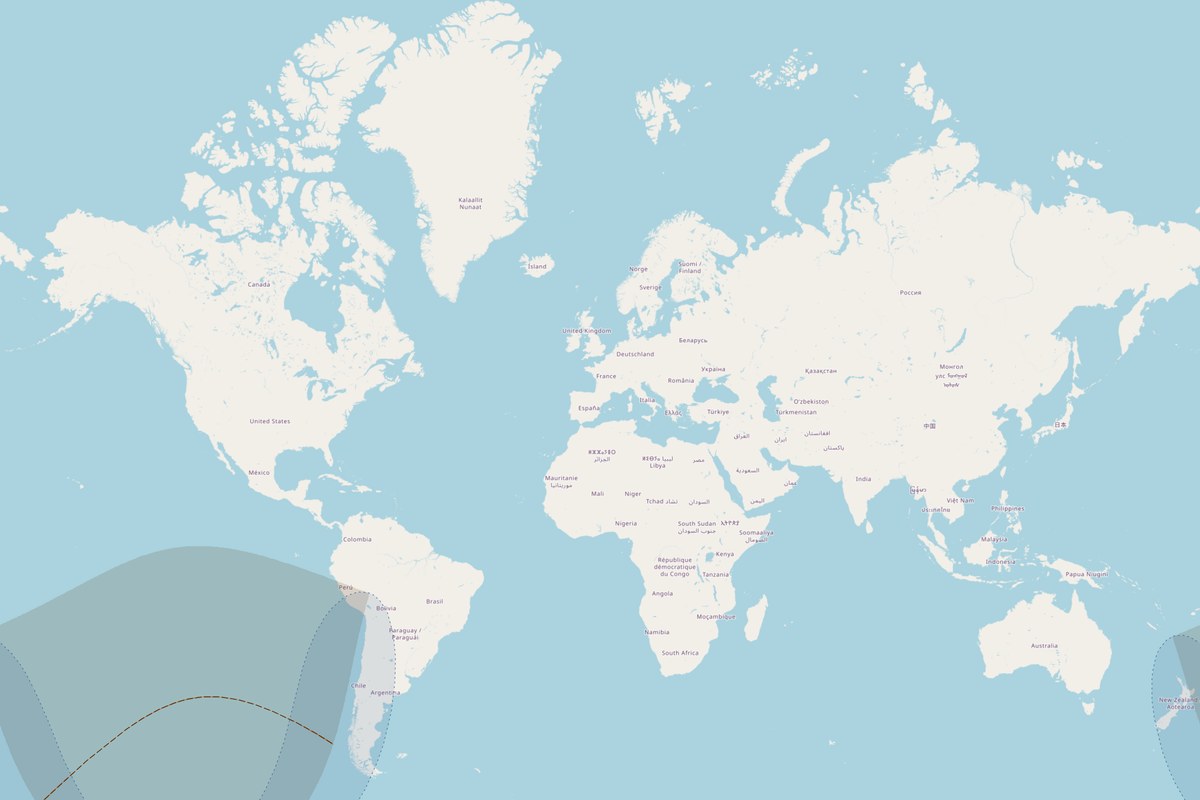
Visibility map — Hybrid eclipse on May 20, 2050

Choose a location anywhere on Earth to see if the eclipse will be visible, check local times, and watch it unfold in an animation.

Explore the eclipse

The central path of this hybrid solar eclipse crosses mainly the South Pacific, far from major populated land. At maximum, the central phase lasts 21 seconds. A partial solar eclipse remains visible in New Zealand, French Polynesia, Pitcairn, Easter Island, and Chile.

Central path

Regions
South Pacific
Example destinations
—

To look at the Sun: eclipse glasses, except during local totality if the disc is completely covered.

Areas with a partial eclipse

Regions
New Zealand, Polynesia, Pitcairn, Easter Island, Chile
Example destinations
New ZealandFrench PolynesiaPitcairnChile

To look at the Sun: eclipse glasses for the whole eclipse.

AucklandNew Zealand

View the eclipse
Key moments of the eclipse
Key moment Local time Obscuration Comment
Partial — start
Sat, May 21
Obscuration 0%
Sun not yet risen
Maximum
Sat, May 21
Obscuration 26.5%
Sun not yet risen
Sunrise
Sat, May 21
Obscuration 26.3%
Sun’s centre on the horizon
Partial — end
Sat, May 21
Obscuration 0%
The Moon no longer covers the Sun

WellingtonNew Zealand

View the eclipse
Key moments of the eclipse
Key moment Local time Obscuration Comment
Partial — start
Sat, May 21
Obscuration 0%
Sun not yet risen
Maximum
Sat, May 21
Obscuration 36.3%
Sun not yet risen
Sunrise
Sat, May 21
Obscuration 35.5%
Sun’s centre on the horizon
Partial — end
Sat, May 21
Obscuration 0%
The Moon no longer covers the Sun

ChristchurchNew Zealand

View the eclipse
Key moments of the eclipse
Key moment Local time Obscuration Comment
Partial — start
Sat, May 21
Obscuration 0%
Sun not yet risen
Maximum
Sat, May 21
Obscuration 29.9%
Sun not yet risen
Sunrise
Sat, May 21
Obscuration 28.3%
Sun’s centre on the horizon
Partial — end
Sat, May 21
Obscuration 0%
The Moon no longer covers the Sun

PapeeteFrench Polynesia

View the eclipse
Key moments of the eclipse
Key moment Local time Obscuration Comment
Partial — start
Fri, May 20
Obscuration 0%
The Moon starts covering the Sun
Maximum
Fri, May 20
Obscuration 19.7%
Maximum obscuration
Partial — end
Fri, May 20
Obscuration 0%
The Moon no longer covers the Sun

Adamstown (Pitcairn)Pitcairn

View the eclipse
Key moments of the eclipse
Key moment Local time Obscuration Comment
Partial — start
Fri, May 20
Obscuration 0%
The Moon starts covering the Sun
Maximum
Fri, May 20
Obscuration 61.6%
Maximum obscuration
Partial — end
Fri, May 20
Obscuration 0%
The Moon no longer covers the Sun

Easter IslandChile

View the eclipse
Key moments of the eclipse
Key moment Local time Obscuration Comment
Partial — start
Fri, May 20
Obscuration 0%
The Moon starts covering the Sun
Maximum
Fri, May 20
Obscuration 69.1%
Maximum obscuration
Partial — end
Fri, May 20
Obscuration 0%
The Moon no longer covers the Sun

ConcepcionChile

View the eclipse
Key moments of the eclipse
Key moment Local time Obscuration Comment
Partial — start
Fri, May 20
Obscuration 0%
The Moon starts covering the Sun
Sunset
Fri, May 20
Obscuration 59.2%
Sun’s centre on the horizon
Maximum
Fri, May 20
Obscuration 60.1%
Sun has set
Partial — end
Fri, May 20
Obscuration 0%
Sun has set

Puerto MonttChile

View the eclipse
Key moments of the eclipse
Key moment Local time Obscuration Comment
Partial — start
Fri, May 20
Obscuration 0%
The Moon starts covering the Sun
Sunset
Fri, May 20
Obscuration 62.6%
Sun’s centre on the horizon
Maximum
Fri, May 20
Obscuration 64.7%
Sun has set
Partial — end
Fri, May 20
Obscuration 0%
Sun has set

Hanga Roa (Easter Island)Chile

View the eclipse
Key moments of the eclipse
Key moment Local time Obscuration Comment
Partial — start
Fri, May 20
Obscuration 0%
The Moon starts covering the Sun
Maximum
Fri, May 20
Obscuration 69.1%
Maximum obscuration
Partial — end
Fri, May 20
Obscuration 0%
The Moon no longer covers the Sun

Watch a solar eclipse safely

To look directly at the Sun, use eclipse glasses that conform to ISO 12312-2 and are in good condition. Ordinary sunglasses do not provide enough protection.

You may look at the Sun without glasses only during totality at your observing location, when its disc is completely covered by the Moon. Put them back on as soon as the Sun begins to reappear. During a partial or annular eclipse, eclipse glasses remain necessary for any direct viewing.

Do not use binoculars, a telescope, a camera, or any other optical instrument unless it is fitted with a suitable solar filter placed in front of the optics. Eclipse glasses are not sufficient in this case.

The information and times shown are provided for guidance only. Each observer must check local conditions and follow the applicable safety guidelines.